Dog Microchip vs GPS Tracker: Why a Chip Can't Find Your Dog
A microchip has no battery and no GPS. It only works after someone scans your dog. Here's what actually finds a lost dog, and when you need both.
On this page 8 sections
Your dog is microchipped. You relax about it, the way you relax about a spare key hidden under a rock. Then the dog slips the leash at the trailhead, and you reach for your phone expecting a map with a blinking dot.
There is no dot. A microchip has no GPS, no battery, and no way to transmit a signal anywhere. It cannot be located, pinged, or opened in an app, because it was never built to do any of that. It is an identification tag that happens to live under the skin instead of on a collar, and it only becomes useful the moment someone else finds your dog and scans it. Understanding that gap, between what a chip actually does and what most owners assume it does, is the difference between a false sense of security and an actual plan for the ten minutes after your dog disappears.
What a microchip actually does
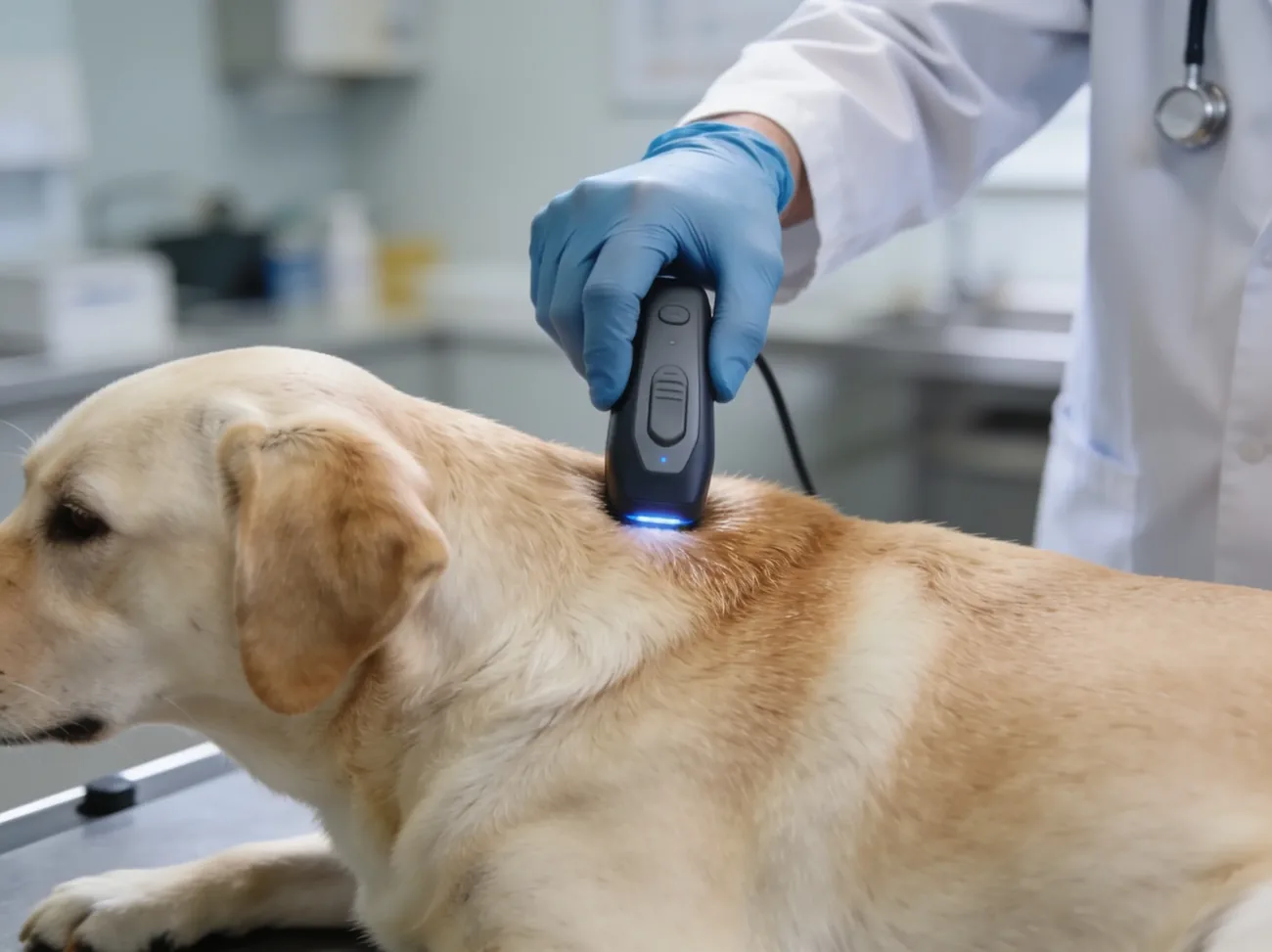
A dog microchip is a passive RFID transponder, a sealed glass capsule about the size of a grain of rice, implanted with a needle between the shoulder blades. It carries no battery and no moving parts. The chip only activates when a scanner passes within 8 to 15 centimeters and sends it a radio pulse, at which point the chip briefly powers itself off that pulse and returns a fixed 15-digit ID number. This handshake follows ISO 11784 and ISO 11785, the international standards that fix the carrier frequency at 134.2 kHz so that a chip implanted in the US reads correctly on a scanner in another country.
That ID number means nothing on its own. It only works because you registered it, alongside your phone number and address, in a database like HomeAgain, AKC Reunite, or Found Animals. When a shelter or vet clinic scans a stray dog and gets a hit, they look up that number in the registry and call the listed owner. Skip the registration step, or move without updating it, and the chip becomes a number nobody can connect to you.
Because there’s no battery, a microchip never dies and never needs a firmware update. It is implanted once and works for the life of the dog. That permanence is also its entire limitation: a microchip has no idea where your dog is until a human being with a scanner finds the dog first.
What a GPS tracker actually does
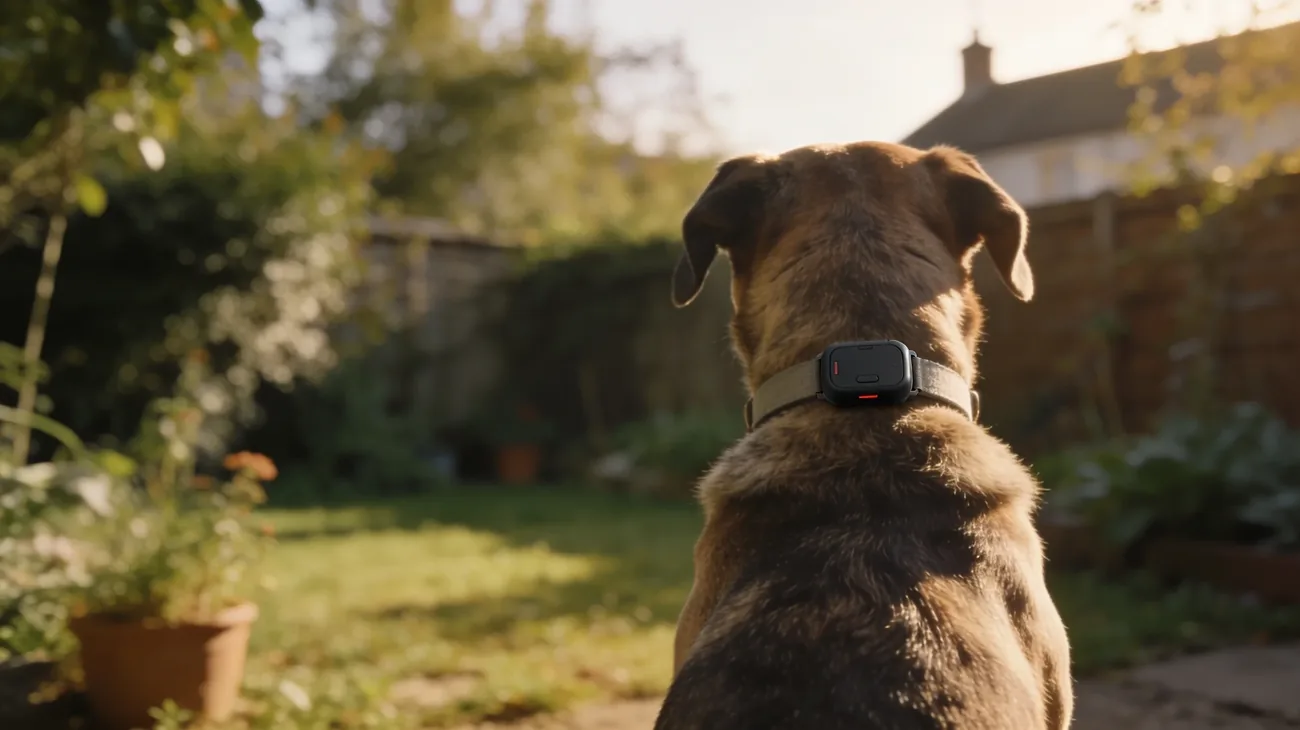
A GPS dog tracker is the opposite kind of device. It clips onto a collar, carries a rechargeable battery, and contains both a GPS chip and a cellular radio. Instead of waiting to be scanned, it actively reads its own coordinates and sends them to your phone over a cell network, the same way your own phone reports its location to Find My or Google Maps.
On a tracker like Tractive, live tracking mode updates every 2 to 3 seconds, so opening the app shows your dog moving in something close to real time, not a location from an hour ago. That comes at a real cost: hardware runs $50 to $130, and the cellular connection means a monthly or annual subscription, typically $5 to $15 depending on the plan length. The battery also needs charging every few days to a week, depending on how often live tracking runs.
A GPS tracker can also draw a virtual fence around your yard and alert you the instant your dog crosses it, something a microchip has no mechanism to do at all. The tracker is a search tool. The microchip is a permanent ID card. Neither one substitutes for the other.
Where the misconception comes from
Part of the confusion is cultural. Movies and crime shows use “microchipped” as a stand-in for “trackable,” the same shorthand used for tagged wildlife or tracked shipping containers. In reality, wildlife biologists who track animal movement use GPS collars with their own batteries and radios, not passive ID chips. The pet microchip industry borrowed the word “chip” from computing, which primes people to picture something active and electronic, when the honest comparison is closer to a barcode sewn into a shirt.
Marketing adds to it. A pet store selling a $60 microchipping service next to a $130 GPS collar has little incentive to clarify that only one of them can find a missing dog. Reading the fine print on any reputable microchip brand’s own site, including PetLink and HomeAgain, confirms the same thing: the chip identifies, it does not locate.
Microchip vs GPS collar vs AirTag on a collar
| Microchip | GPS collar tracker | AirTag on collar | |
|---|---|---|---|
| What it does | Stores a permanent ID number, read by a scanner | Sends live coordinates over cellular network | Pings off nearby iPhones in Apple’s Find My network |
| Range | 8-15 cm, scanner must touch the dog | Unlimited, anywhere with cell signal | 30-100 meters Bluetooth to the nearest iPhone |
| Battery | None, passive and permanent | Rechargeable, lasts 2-7 days per charge | CR2032 coin cell, about 1 year |
| Cost | $25-$70 one-time | $50-$130 hardware plus $5-$15/month | $29 one-time, no subscription |
| Finds a lost dog? | No, only confirms identity after the dog is found | Yes, actively, wherever there is cell coverage | Sometimes, only where iPhones are nearby |
The pattern in that table is the whole argument. A microchip and an AirTag both look inexpensive next to a GPS collar, but only the GPS collar actually searches for your dog. The chip and the AirTag both depend on someone or something else being in the right place: a scanner in the chip’s case, a stranger’s iPhone in the AirTag’s case. For more on how AirTag specifically compares to a purpose-built GPS collar, see AirTag vs GPS dog tracker: which finds a lost dog, and for the mechanics of mounting a tag on a collar safely, see can you put an AirTag on your dog’s collar. The same logic applies to cats, where weight matters even more: see best Bluetooth tracker for a cat collar for the lightest options that won’t exceed the 5 percent body-weight rule.
The numbers behind “the chip worked”
The strongest case for microchipping isn’t intuition, it’s a controlled study. Research published by Dr. Linda Lord and colleagues, covering 53 animal shelters across 23 states and 7,704 stray animals, found that microchipped dogs were returned to their owners 52.2 percent of the time, compared with 21.9 percent for dogs without a chip. For cats the gap was even larger: 38.5 percent return rate with a chip versus 1.8 percent without one, according to the study summarized by ScienceDaily.
That data makes a clean case for microchipping every dog, full stop. It also makes clear what the chip is measuring: return-to-owner rate after the dog reaches a shelter or clinic. It says nothing about how fast the dog gets there, how far it wanders in the meantime, or whether it crosses a road on the way. A GPS tracker changes a different number entirely: how long the dog is loose and how much of that time you spend not knowing where it is.
When you actually need both
The American Veterinary Medical Association and most shelter medicine programs recommend microchipping every dog regardless of whether the owner also uses a GPS tracker, and that advice holds up against the data above. The two devices solve problems that don’t overlap.
Consider the failure modes each one covers:
- Collar falls off during the chase. A GPS tracker mounted on that collar goes dark with it. The microchip stays under the skin and still works when the dog is eventually found.
- Dog wanders for days before anyone spots it. A tracker with a dead or out-of-range battery is useless by then. The chip, still permanent and unpowered, gets scanned the moment the dog reaches a shelter.
- Dog is actively running right now, ten minutes ago. The chip does nothing until someone catches the dog. A live GPS signal is the only thing that gets you to the dog while it’s still moving.
- Dog is stolen and re-homed. A registered microchip is often the deciding evidence in a legal ownership dispute. A GPS tracker, if the thief finds and removes it, provides nothing.
Run both and you cover the two halves of the same emergency: the chip proves who the dog belongs to once found, the tracker helps you find the dog before that ever needs to happen.
Cost over two years, side by side
Microchip: $25-$70 once, at implantation. No subscription, no battery, no renewal fee beyond the occasional $15-$20 registry update if you switch providers.
GPS tracker (Tractive, mid-tier plan): $50-$69 hardware, plus roughly $60-$120 a year on an annual plan, for a two-year total in the $170-$300 range depending on the term length chosen.
AirTag: $29 once, no subscription, but it depends on Apple’s Find My crowd network rather than its own GPS, so it works unevenly outside cities.
Over a dog’s typical 10 to 14 year lifespan, the microchip remains a single small cost. The GPS tracker is a recurring line item, closer to what you’d budget for a second streaming subscription, and it only pays off if your dog is genuinely at risk of getting loose in a place where cellular coverage, not luck, is what finds them.
What to actually do if your dog goes missing today
If your dog is already gone, the chip and the tracker point you toward different first moves. With a GPS tracker, open the app immediately and follow the live pin; most trackers also let you trigger a locate ping if the signal has gone idle. Without one, or while you wait for that battery to catch a signal, call the shelters and emergency vet clinics within a 10-mile radius and ask them to flag your dog’s description, since a found dog usually gets scanned within hours of arrival.
Confirm your microchip registry contact information is current before anything happens, not after. A 2017 review by the AVMA found that outdated owner information, not missing chips, is the single most common reason a scanned dog never makes it home. That’s a five-minute fix you can do right now, chip already implanted or not.
Most shelters scan every stray dog within the first hour of intake, before paperwork is even finished, because a chip hit can end the search with one phone call. That’s also why a collar tag with a current phone number still matters even after microchipping: a stranger who finds your dog on the street has no scanner, but can read a tag and call you directly, often hours before the dog ever reaches a shelter or clinic. The chip, the tag, and the tracker cover three different gaps in the same emergency, and none of them replace the other two.
Questions & answers
Things readers ask about this
7 questions · updated Jul 2026