Can You Put an AirTag on Your Dog Collar? Apple Says No, Here's Why
AirTag is a Bluetooth crowd-sourced finder, not a GPS tracker. What it does for a dog, what it cannot, and the four real pet trackers worth $5 to $10 a month.
On this page 8 sections
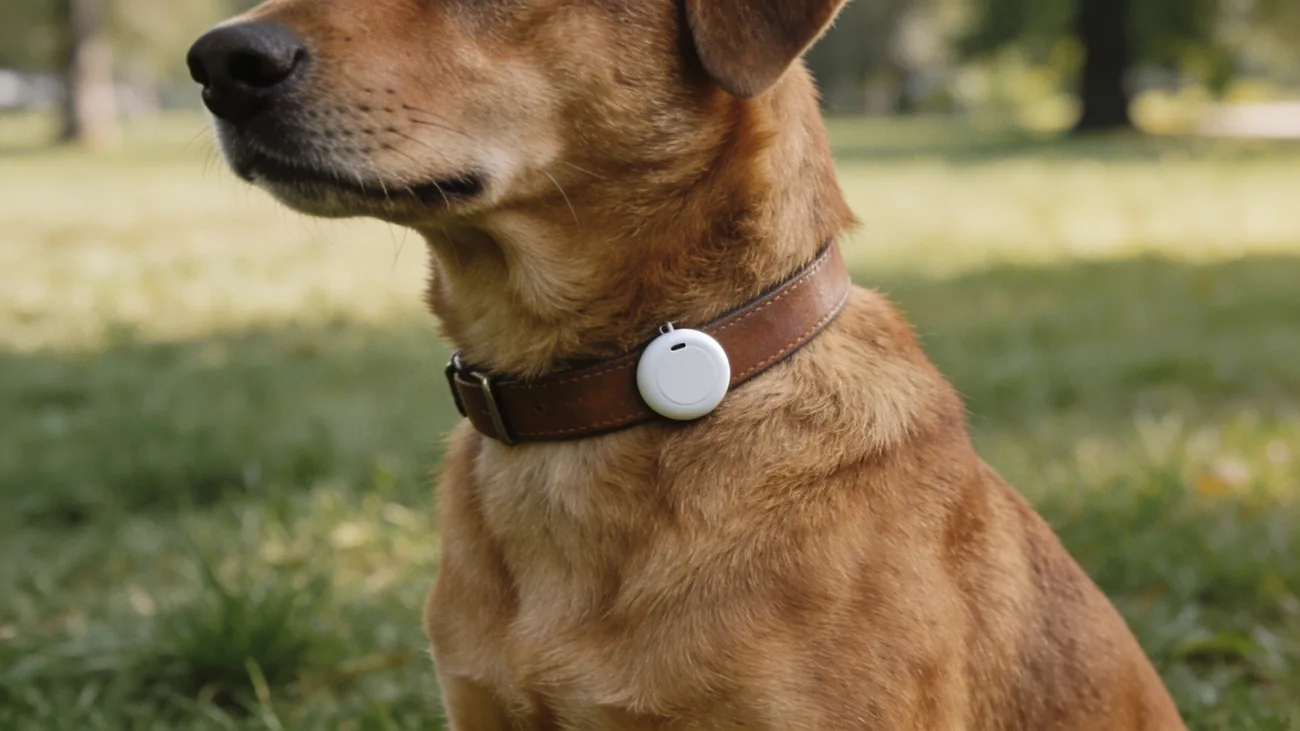
Walk into any pet store and you will see AirTag dog collars on the rack. Search Amazon and the listings number in the thousands. Open Apple’s own product page and there is one sentence, repeated across the user guide and the marketing copy: AirTag is designed to track items, not people or pets.
This is not a corporate-liability dance. It is an accurate description of how the product actually works, and why it is a bad fit for most dogs and an acceptable fit for a narrow set of others. The honest version of this question takes ten minutes to walk through.
TL;DR. AirTag has no GPS. It pings off nearby iPhones in Apple’s Find My network and reports that location. In a city, that can mean useful updates every few minutes. In a forest, it can mean no update for hours. Real GPS pet trackers (Tractive, Fi, Whistle, Jiobit) cost $50 to $130 once and $5 to $20 a month, give true real-time location, and add features AirTag was not built for. AirTag works as a city safety net or a redundant backup. As the only tracker on a hiking dog, an off-leash dog, or a swimmer, it is the wrong product.
What AirTag actually is, in one paragraph
AirTag is a Bluetooth Low Energy beacon with a U1 ultra-wideband chip and a CR2032 coin battery. It transmits an encrypted identifier every two seconds. Any iPhone, iPad, or Mac running iOS 14.5 or later that comes within roughly 30 to 100 feet picks up the signal, hashes the device’s location, and uploads the pair to Apple’s Find My network. You see the location on your phone. The tag itself never knows where it is.
Three consequences flow from that architecture, and they are the entire story of why AirTag is not a pet tracker:
- No GPS means no real-time position. The tag can only be located when an Apple device is nearby.
- Crowd-sourced relay means the location density depends on how many iPhones are around. New York: dense. Yellowstone: sparse to none.
- Two-second BLE pings means battery life of about a year, but no live mode like a cellular tracker can run for short bursts.
Why Apple says no to pets
Apple does not just ignore the pet use case. The company has gone on record. Kaiann Drance, Apple’s vice president of iPhone marketing, said publicly at AirTag’s launch that the device is for items, not for pets or people. The user guide that ships with every AirTag carries the same line.
Two engineering reasons sit underneath the policy:
- Anti-stalking features fire on moving targets. Apple introduced AirTag with anti-stalking alerts: an iPhone that detects an unknown AirTag traveling with it for several hours pings the user. Android has Tracker Detect doing the same job. A neighbor or dog walker who takes your dog out for an hour gets a phantom alert that an AirTag is following them. The window has been narrowed in iOS updates from 3 days to 8-to-24 hours, which makes the false positive worse, not better, on pets.
- The product was never tuned for live updates. AirTag’s ping interval and battery design assume an item that mostly sits still: keys in a coat, a wallet on a table, a backpack at school. A dog at a dog park is the hard case.
What goes wrong on a dog
Beyond the location-quality issue, three physical risks come up in vet practices and forum threads often enough to be worth naming.
Swallowing. AirTag is 31.9 mm in diameter, about the size of a US quarter. A medium-to-large dog can swallow one. Coin-cell battery ingestion is a known veterinary emergency because the battery causes electrolyte burns and tissue necrosis if it lodges. If the AirTag shell cracks in the dog’s mouth and the battery is exposed, the risk goes from theoretical to immediate.
Chewing damage. Even without swallowing, a determined chewer can crack the plastic case in minutes. The seal that gives AirTag its IP67 rating fails, and the device dies on the next rain. Hard-shell holders (silicone outer, hard plastic inner) extend life. Soft pouches do not.
Water exposure. IP67 means 30 minutes in 1 meter of fresh water. Splash, drizzle, the occasional puddle: fine. A swimming session at a lake: not fine. A retriever or any breed that goes in water regularly will outlive several AirTags before the year-long battery would have run out.
The Bluetooth-vs-GPS gap, in real numbers
The AirTag-vs-GPS-tracker comparison is more useful with concrete numbers than with marketing copy.
| Feature | AirTag | Tractive (LTE) | Fi Series 3 |
|---|---|---|---|
| Hardware cost | $29 | $49 to $69 | about $99 |
| Subscription | none | $5 to $10/mo | $99 to $200/yr |
| Location source | Bluetooth via passing iPhones | Real GPS + cellular | Real GPS + LTE |
| Live update interval | only when an iPhone is near | 2 to 3 seconds in Live Mode | a few seconds in Live |
| Worldwide cellular range | none | yes | US-focused |
| Battery life | up to 1 year | charges weekly | up to several months |
| Waterproof | IP67 (splash) | IPX7 (swim-rated) | swim-rated |
| Escape alerts / virtual fence | no | yes | yes |
| Activity / health metrics | no | yes | yes |
The honest read of that table: AirTag wins on price and battery life. The GPS trackers win on every other axis that matters for a moving animal.
A city user whose dog is fenced and rarely roams, who has a dense iPhone footprint, gets meaningful value from a $29 AirTag in a hard-shell collar holder. A user with a hunting dog, an off-leash hiking dog, a frequent escapist, or any dog that swims has the wrong tool and is one bad afternoon away from learning that.
When AirTag actually fits
There are real cases. Naming them precisely matters more than ruling them out:
- A dense urban dog: Manhattan, Brooklyn, San Francisco, central Boston. The Find My footprint is so thick that a dog moving through any block is pinged within a minute or two. The AirTag becomes a usable backup if the dog slips off-leash or the leash hand fails. Cost: $29 once, no subscription, no active management.
- A backup tag on a dog with a real GPS collar: Tractive or Fi failure modes are real (forgot to charge, lost SIM signal, battery died), and a $29 AirTag in a separate holder is the redundant layer.
- An indoor cat that occasionally escapes: cats stay close to home, the building is full of iPhones, the AirTag’s lack of GPS is irrelevant inside an apartment block.
- A travel-only tag inside a carrier or crate: tracking the carrier on a flight or in a hotel is exactly the item-tracking case AirTag was built for.
In each, the dog is moving inside a high-iPhone-density envelope or AirTag is supplementary. Outside those bounds, the architecture stops working in a way that matters.
When AirTag is the wrong product
The inverse list:
- Hiking and trail dogs: phone density is sparse and update intervals stretch to hours. By the time you have a location, the dog has moved a mile.
- Off-leash hunting and working dogs: same problem, plus high water and chew exposure.
- Swimmers: IP67 is not enough.
- Escape artists: an AirTag has no virtual fence, no instant escape alert. By the time the next iPhone passes the dog, the dog is half a town away.
- Small dogs and puppies under 10 pounds: the swallow and chew risk is highest, and the collar payload of an AirTag-plus-holder is heavy relative to the dog.
For any of these, a Tractive, Fi, Whistle GO, or Jiobit at $50 to $130 hardware and $5 to $20 a month is the right answer, not a $29 AirTag with limitations the marketing copy on the collar holder will not warn you about.
The four real GPS pet trackers worth comparing
If you are crossing into real-tracker territory, the field has consolidated:
- Tractive: best price-to-features ratio. $49 to $69 hardware, plans from $5 a month on a 5-year prepay to $10 a month on the annual Premium. Real-time GPS, virtual fence, swimming-rated, available in most countries with cellular coverage. The default first-time GPS pet tracker.
- Fi Series 3: about $99 hardware plus a $99-to-$200-per-year subscription. Excellent battery life on standby, LTE-M cellular, US-focused. Strong if you are in the US and want long battery between charges.
- Whistle GO Explore: roughly $130 hardware plus $99 a year. Heavier on activity and health metrics than the others. Owned by Mars Petcare, sold in most US pet retailers.
- Jiobit: about $130 hardware plus $9 to $14 a month. Smallest of the four, suitable for cats and toy breeds. Owned by Life360.
For all four, the subscription is the irreducible cost. The cellular SIM inside each tracker is what makes real-time GPS possible at all. No subscription means no location, the same way no monthly bill means no cell service on your own phone. AirTag avoids the subscription only because it offloads the network to other people’s iPhones.
The 30-second decision
If you read no further:
- Buy a real GPS pet tracker ($50 to $130 once, $5 to $20 a month) for any dog that hikes, swims, escapes, lives rurally, or matters enough to you that a 4-hour Find My delay would be unacceptable.
- Buy an AirTag and a hard-shell holder ($29 plus $10 to $20) only if your dog lives in a dense urban iPhone footprint, fenced or leashed almost always, and you can accept that the tag is a low-cost safety net rather than a primary tracker.
- Use both if budget allows; the GPS does the active work, the AirTag is the redundant layer.
- Never put an unprotected AirTag on a chewer, near a swimmer, or as the only tracker on a working dog. For cats specifically, the math runs against AirTag for different reasons (weight, swallow risk, breakaway failure); our Bluetooth tracker picks for cat collars covers the lighter alternatives that fit a feline neck.
Apple’s “no, do not use this for pets” is correct, accurate, and worth listening to. The product is not bad. It is not designed for the use case the collar holders imply.
Questions & answers
Things readers ask about this
7 questions · updated May 2026