How to Track a Phone by IMEI Number: What Actually Works
The truth about IMEI tracking: what you can and can't do with an IMEI number, how carriers and police use it, and realistic steps to recover a stolen phone.
On this page 8 sections
- The honest answer: no, you cannot track a phone by IMEI on your own
- What an IMEI number actually is
- How to find your IMEI before you lose your phone
- What carriers can (and will) do with an IMEI
- How police actually track stolen phones
- Country-specific IMEI block processes
- Why IMEI tracking websites are scams
- Realistic recovery path: a 6-step plan
If you landed here after losing a phone, you are probably looking for a website that takes an IMEI and returns a map pin. That tool does not exist for ordinary users, and every site claiming otherwise is selling something else.
This guide covers what an IMEI is, what carriers and police can do with it, how IMEI blocking works across the US, UK, and EU, and the six-step plan that actually gets stolen phones recovered or rendered useless. The information comes from the GSMA TS.06 standard documentation, the CTIA Stolen Phone Checker portal, the UK NMPR / Immobilise registry, India’s Sanchar Saathi public CEIR, the Stored Communications Act (18 U.S.C. § 2702), and direct review of US carrier lost-or-stolen procedures.
The honest answer: no, you cannot track a phone by IMEI on your own
Regular users cannot locate a phone using just an IMEI. Not for free, not by paying, not with any app you can install on your laptop.
The only systems that map an IMEI to a location are cell tower logs maintained by carriers. Those logs are protected by federal law in the US (Stored Communications Act, 18 U.S.C. § 2702) and by GDPR plus national telecom rules in the EU. Carriers release that data only to law enforcement with a subpoena or court order.
Even your own carrier will not show you the live location of a phone on your account. They will block the IMEI, suspend service, and cooperate with police. They will not give you GPS coordinates.
The tools that actually find phones are Find My iPhone and Find My Device, which work through the device’s GPS and your account login, not through the IMEI.
What an IMEI number actually is
IMEI stands for International Mobile Equipment Identity. It is a 15-digit number that uniquely identifies a physical cellular device. Every phone, tablet, and cellular-enabled smartwatch sold legally has one; dual-SIM phones have two.
The IMEI is assigned through the GSMA, which maintains the central IMEI database that GSM-family operators use to validate devices. The first eight digits are the Type Allocation Code (TAC), which identify the manufacturer and model.
A few related identifiers people confuse with IMEI:
| Identifier | What it identifies | Where it lives |
|---|---|---|
| IMEI | The physical device | Burned into the modem |
| ICCID | The SIM card | Printed on the SIM, 19-20 digits |
| MEID | Older CDMA devices | Mostly retired in 2026 |
| eSIM EID | The embedded SIM chip | 32 digits, in the device |
Swap SIM cards and the IMEI stays. Swap phones and the ICCID stays. That distinction matters when reporting a stolen device.
How to find your IMEI before you lose your phone
Do this now, while you still have the device. Save the number in a password manager.
On any phone: open the dialer and type *#06#. The IMEI appears on screen. This works on iPhone, Android, and most feature phones because it is part of the GSMA TS.06 standard.
On iPhone: Settings > General > About. Scroll to IMEI. iPhone 14 and newer US models are eSIM-only with no SIM tray, but the IMEI is still in About.
On Android (Pixel 8, Galaxy S24, etc.): Settings > About phone > IMEI. On Samsung devices it may sit under Status information.
Other places it lives:
- The original retail box, on the barcode label
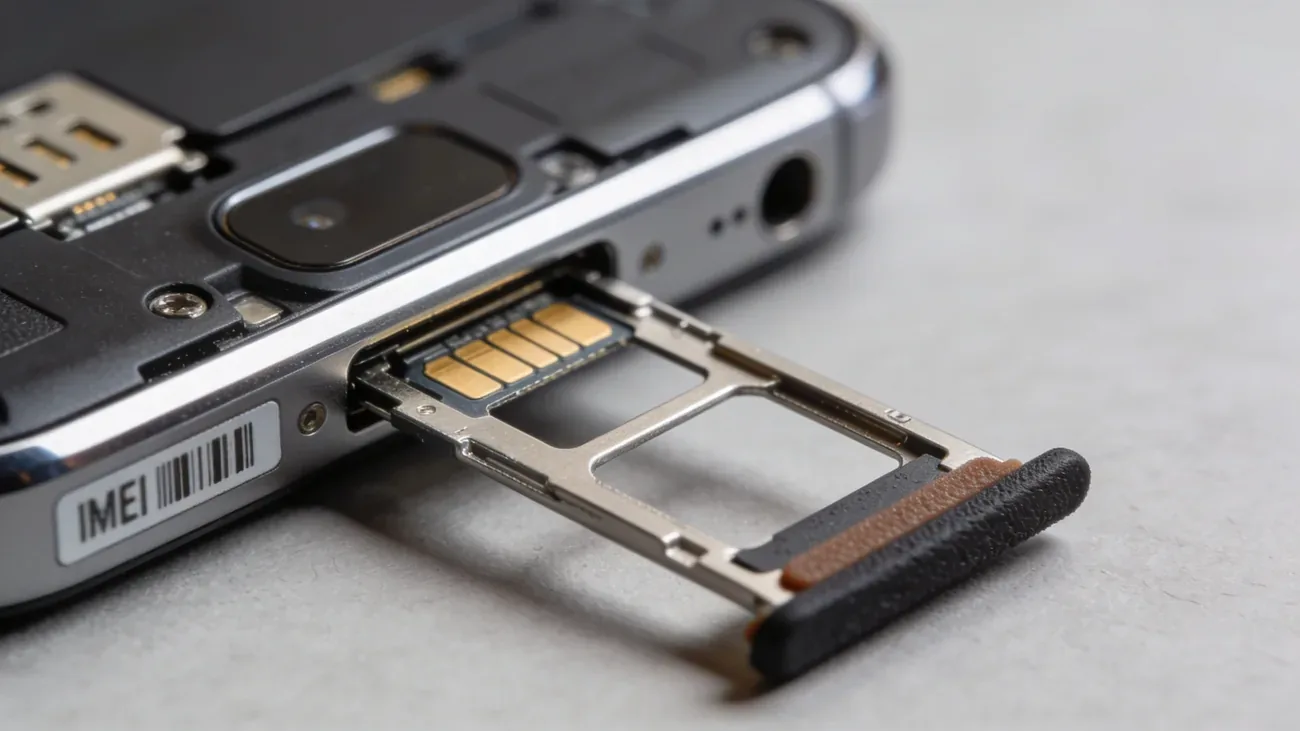
- The SIM tray on iPhone 13 and earlier non-US models
- Your carrier account dashboard
- Apple ID device list at appleid.apple.com
- Google Account > Security > Your devices, for signed-in Android phones
Photograph the box label the day you unbox the phone. That habit alone has saved thousands of insurance claims.
What carriers can (and will) do with an IMEI
Carriers do three things with a stolen-IMEI report:
- Suspend service on the SIM tied to that IMEI, stopping calls, texts, and data on your account.
- Add the IMEI to the national blacklist so the device cannot register on participating networks in that country.
- Provide historical cell tower logs to law enforcement under subpoena, placing the device near specific towers at specific times.
The cell tower log confuses people. Yes, your carrier knows roughly where the phone has been; every tower connection is logged with IMEI, ICCID, and timestamp. No, you cannot see this log. Neither can a private investigator. Only law enforcement with a court order can pull it, and accuracy is sector-level, not pin-on-a-map.

How police actually track stolen phones
Police investigations follow a predictable path. Knowing it helps you file a useful report.
- You file a police report with the IMEI, time, location, and any Find My history showing the phone moving.
- The officer assesses value and evidence. Most US jurisdictions only open active investigations above a state-specific dollar threshold or when there is a clear suspect.
- If opened, the detective sends a preservation letter to the carrier, then a subpoena for cell tower data.
- The carrier returns historical connection records showing which towers the IMEI hit and when.
- Police use Find My location history if available, since it is far more precise than tower triangulation.
This takes days to weeks, not hours. Phones are most often recovered when the thief tries to resell and the buyer runs an IMEI check first.
Country-specific IMEI block processes
Each country runs its own Central Equipment Identity Register (CEIR), and the rules differ. Here are the four largest systems users actually interact with.
United States: CTIA and GSMA
US carriers (Verizon, AT&T, T-Mobile, US Cellular) feed a shared GSMA-linked blacklist. Call your carrier’s lost-or-stolen line within 24 hours, provide the IMEI and police report number, and the carrier uploads it to the GSMA Device Registry within 24 to 48 hours.
Anyone in the US can verify a device against this list using the CTIA Stolen Phone Checker at stolenphonechecker.org. The database has been used to block millions of devices since launch in 2012.
United Kingdom: NMPR via Immobilise
The UK runs the National Mobile Property Register (NMPR), accessible to consumers through Immobilise, which is free and supported by all UK police forces. Register the IMEI on Immobilise, report the theft to your carrier (EE, O2, Vodafone, Three) with the police crime reference number, and the block propagates to UK networks within roughly 24 hours. CheckMEND queries the same dataset for used-phone buyers.
European Union: country-by-country CEIR
There is no single EU-wide CEIR. Each member state operates its own register and feeds the GSMA cross-border list voluntarily. France runs a shared blacklist among Orange, SFR, Bouygues, and Free, coordinated through ARCEP. Germany splits oversight (Bundesnetzagentur) from operation (individual carriers). Spain, Italy, and Poland run national CEIRs through their telecom regulators.
Process is identical everywhere: police report first, carrier block second, propagation in 24 to 72 hours. EU regulators are working toward a unified CEIR but had not finalized it as of 2026.
India: Sanchar Saathi
India’s Department of Telecommunications runs sanchar-saathi.gov.in, which lets any citizen block a stolen phone’s IMEI directly through the CEIR portal without going through the carrier first. India was the first major country to give consumers direct CEIR access, and the system has blocked over 1.4 million handsets since launch.
Why IMEI tracking websites are scams
Search “free IMEI tracker” and you will find dozens of polished sites promising live location for any phone given just the IMEI. Every one is a scam. The red flags:
- They ask for the IMEI plus a phone number, email, or payment. A real lookup tool would not need any of that.
- A fake loading animation runs for 30 to 60 seconds, then a “verification required” wall appears.
- Verification asks you to install an app, complete a survey, or enter card details for a “processing fee”.
- No company name, no address, no privacy policy that names a real legal entity.
- Reviews look generated, with five-star copy-paste comments dated within days of each other.
- They claim partnerships with Apple, Google, or carriers that do not exist.
Some third-party apps claim IMEI tracking but use other mechanisms under the hood, usually the victim’s own Find My iPhone or Find My Device credentials harvested through phishing. If any tool asks for your Apple ID password or Google account login to “track via IMEI”, close the tab.
The honest tools are built into the device: Find My iPhone and Find My Device. They locate the phone by GPS, not by IMEI.
Realistic recovery path: a 6-step plan
This is the sequence that actually works when a phone goes missing. Run it in order, fast.
Step 1, Locate via Find My within the first hour. Open icloud.com/find or android.com/find, sign in, and check the map. If the phone is online, you see its current location; if offline, the last known position. Do not chase a moving phone alone; pass the location to police.
Step 2, Mark as Lost or Lost Mode. Both Apple and Google let you lock the screen with a custom message and contact number, suspend Apple Pay or Google Pay, and disable notifications. This stops opportunistic data theft and signals to a finder that the phone is being tracked.
Step 3, File a police report. Get a crime reference number. Include the IMEI, the device color and model (e.g., iPhone 15 Pro Max 256GB Natural Titanium), Find My location history, and the time of loss. The crime number unlocks insurance claims and IMEI blocking.
Step 4, Block the IMEI with your carrier. Call your carrier’s lost-or-stolen line. They will suspend the SIM and add the IMEI to the national blacklist. In the US, this also feeds the GSMA Device Registry; in India you can do it yourself via Sanchar Saathi.
Step 5, File the insurance claim. AppleCare+ with Theft and Loss, Samsung Care+, carrier insurance (Asurion, Verizon Mobile Protect), and home contents policies all require the police report number and IMEI. File within the policy window, often 60 days.
Step 6, Trust the activation lock. Apple’s Activation Lock and Android’s Factory Reset Protection mean the phone cannot be wiped and resold without your account credentials. A stolen iPhone is worth more in parts than as a working device on the resale market, which is why theft rates have dropped since these features rolled out. Keep the lock on; do not be tempted to remove it.
If you want a deeper technical view of how this all fits together, see how phone location tracking actually works for the carrier and GPS side of the picture.
The phone may still come back. Many do, weeks later, when a buyer runs an IMEI check and walks away. But set honest expectations: IMEI is for blocking, Find My is for locating, police are for investigating. Anyone selling a fourth option is selling nothing.
Questions & answers
Things readers ask about this
5 questions · updated Apr 2026