How to Detect a GPS Tracker on Your Car: The DIY Sweep
A 30-minute five-zone visual sweep, what an RF detector actually finds, when to call a TSCM pro, and the call to make first if a partner planted it.
On this page 7 sections
Most articles on this topic open by selling fear. The truth is calmer. The vast majority of cars do not have a tracker on them, the ones that do are usually one of three predictable types, and a 30-minute search with a flashlight finds most of them.
The harder version of this problem is the small minority of cases where a current or former partner planted the device. That changes the playbook entirely. Before any sweep, the first call is to a domestic-violence advocate, not a mechanic.
TL;DR. If a partner or ex placed the tracker, stop here. Call the National Domestic Violence Hotline at 1-800-799-7233 first. Removing a tracker can tip off the person watching you and put you at greater risk. For everything else, a 30-minute visual sweep covers the OBD-II port, wheel wells, undercarriage, bumpers, and cabin. A $50 RF detector is a useful second pass. A 30-minute lift-and-look at a mechanic is the most underrated upgrade. A professional TSCM sweep is the right answer for high-stakes cases.
Read this first if a partner is the suspected source
Of all the people searching for “GPS tracker on my car,” the smaller share but most at-risk are people who suspect a current or former partner. For that specific case, the order of operations is the opposite of what feels intuitive.
- Do not remove the device immediately. Removing it tells the person watching that you found it. Sudden silence after months of constant data is itself a signal.
- Call before you touch. The National Domestic Violence Hotline at 1-800-799-7233 has technology-abuse advocates trained for exactly this scenario. They will help you decide whether to leave it in place, document it for law enforcement, or neutralize it without removal (a Faraday signal-blocker pouch, $15 to $30, stops transmission without disturbing the device).
- Preserve evidence. Photograph the tracker in place with timestamps. Note the make, model, and any serial numbers visible on the housing. A device removed and tossed in a drawer is forensically weaker than one documented in the car.
- Use WomensLaw.org for state-by-state legal guidance. Stalking statutes vary, and so does what evidence police will accept.
For survivors and advocates, the Coalition Against Stalkerware and the NNEDV Safety Net Project are the two best US-side resources. The same doubt often extends to the phone itself, and the signs of phone surveillance are different from what a car sweep finds.
If you are confident the source is not a partner (suspected work surveillance, a sold-car carryover, a parent-on-teen install you want to confirm), the rest of this guide is the practical sweep.
What you are actually looking for
Three categories of GPS tracker get installed on private vehicles. Knowing which type you are searching for narrows the hiding spots fast.
Magnetic battery trackers. Self-contained units the size of a deck of cards, with a strong neodymium magnet on the back. Slap them on any steel surface in five seconds. Battery life is 30 days to a year depending on ping interval. Examples: LandAirSea 54, Spytec STI GL300, BrickHouse Spark Nano. Hidden under the car or inside wheel wells. Visible to the naked eye if you look in the right place.
Hardwired trackers. Spliced into the vehicle’s 12-volt system, usually behind the dashboard or in the engine bay. Pull from the constant-power line so they run forever and never need recharging. Installation takes 15 to 30 minutes for someone who knows the wiring. Used by fleet operators, repo lenders, and occasionally jealous partners with mechanical skill. Look for new wires that don’t match factory loom or color.
OBD-II trackers. Plug straight into the diagnostic port under the driver’s dashboard. Powered by the vehicle, no installation needed, two-second deployment. Examples: Bouncie, Vyncs, MOTOsafety. The first place to check, every time.
A fourth category is worth naming separately because it does not involve a physical tracker at all: manufacturer connected-car apps. More on that below.
The five-zone visual sweep
Plan on 30 minutes and a flashlight. Do this in a private spot (your driveway, a garage) and not under streetlights where someone can see you searching.
Zone 1: OBD-II port (driver’s-side dashboard, 5 minutes)
Slide into the driver’s seat and look at the underside of the dashboard, within two feet of the steering column. The OBD-II port is a 16-pin trapezoidal connector, sometimes hidden behind a small plastic flap. Anything plugged into it that you did not put there is a tracker until proven otherwise.
Some OBD-II trackers (the original Bouncie hardware, for example) are barely larger than the connector itself and sit nearly flush. Look for any device or dongle, no matter how small. Pull it out by hand, no tool needed. If it is a tracker, the LED on it usually goes dark when unplugged.
If you find one and you are not in a domestic-abuse scenario, photograph it in place, then unplug. If you are in that scenario, stop, call the hotline, and follow their advice.
Zone 2: Wheel wells, all four (8 minutes)
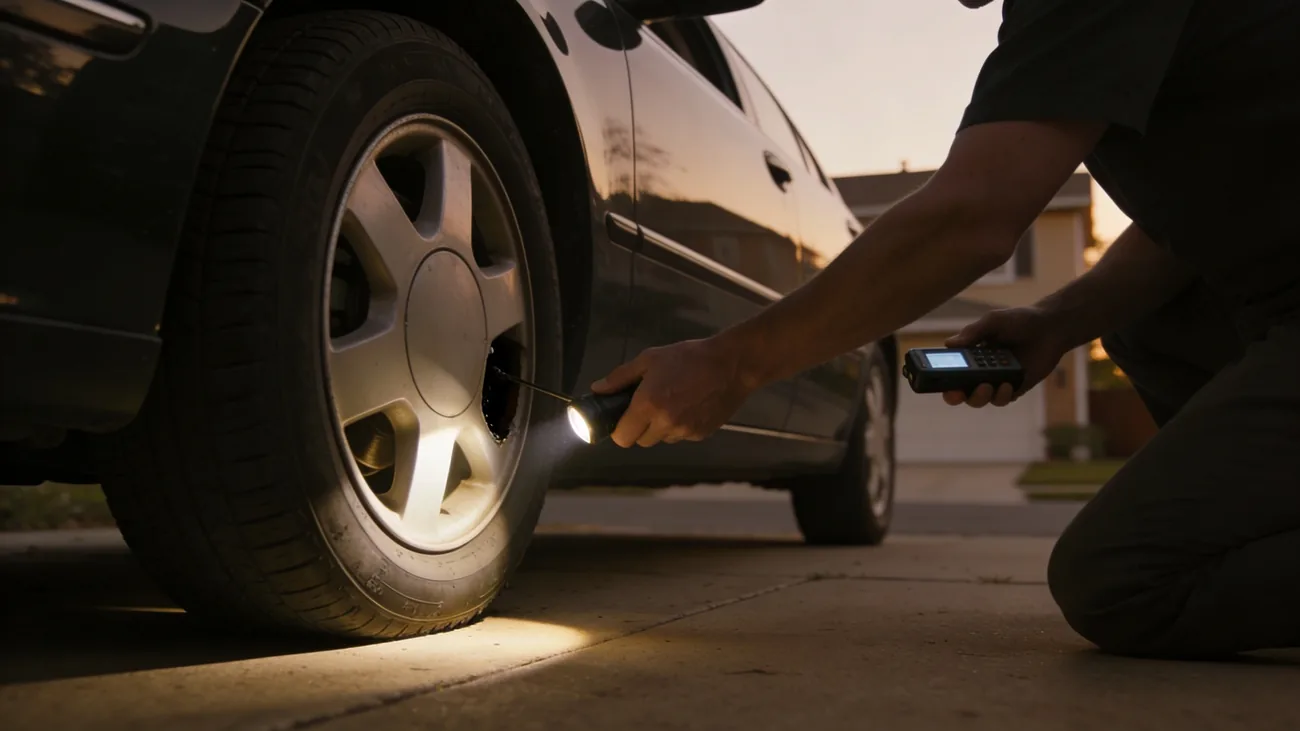
Magnetic trackers love wheel wells: lots of steel surface, hidden from above, dirty enough that nobody looks. Crouch down and run a flashlight along the inside of each wheel well, paying attention to:
- The top arch (above the tire, hardest place to see, easiest place to hide)
- The frame rail behind the wheel
- Any flat steel surface near the strut tower
A magnetic tracker feels like a small smooth box stuck flat. If you can grab it and feel resistance, it is magnetic. Do not remove it yet if there is any chance the source is hostile (see safety section above).
Zone 3: Undercarriage and exhaust area (8 minutes)
Lie on a creeper or a piece of cardboard and shine a flashlight along the underside of the car. Focus on:
- The frame rails along both sides
- The fuel-tank shield (a flat metal plate, easy magnet target)
- The rear differential or sub-frame on RWD/AWD vehicles
- The flat area near the exhaust heat shield
Skip the exhaust pipe itself: too hot for any tracker to survive. Skip moving suspension parts: a tracker would not last a week. Steel surfaces near body panels are the targets.
If your car is too low or you are not comfortable on the ground, this is the zone where a $50-to-$100 mechanic appointment pays off. Ask for a 30-minute lift-and-look and have them check for “any aftermarket device on the chassis or wiring.”
Zone 4: Bumpers, grille, and license plate (5 minutes)
Pop open the front grille if you can, and look behind both bumpers. The cavities behind plastic bumper covers are the second-most common magnetic-tracker spot after wheel wells, because the plastic doesn’t shield GPS or cellular signals.
The license plate area: check both the front frame and the rear, including any custom plate cover. A tracker zip-tied to the plate bracket, or hidden inside a hollowed plate frame, is a real install pattern.
Zone 5: Interior cabin and trunk (4 minutes)
Inside the car, the patterns are:
- Under both front seats. Look for anything taped or velcroed.
- Behind the glove box. Most glove boxes can be unsnapped past their stops to drop further; check for devices spliced into the wiring or HVAC ducts.
- Spare-tire well. Lift the trunk floor panel. Anything not factory belongs there.
- Trunk side panels. Particularly near the third brake light wiring.
- Center console and armrest storage. Less common but trivial to check.
If you reach the end of all five zones and have found nothing, the visual sweep is done. The next-most-common cause is software, not hardware.
When to use an RF detector (and what it actually catches)
A handheld RF detector ($30 to $100 for the consumer range; the Amazon best-sellers cluster around $40 to $60) sweeps the bands cellular GPS trackers use: 850 MHz and 1.9 GHz for cellular uplink, 2.4 GHz for Bluetooth and Wi-Fi side channels.
Procedure:
- Park in a quiet spot away from cell towers, Wi-Fi, and other vehicles.
- Turn off your phone or leave it 20 feet away (it will set off the detector).
- Set sensitivity to maximum.
- Sweep slowly within two inches of every surface, especially the spots from the visual sweep.
- The detector will beep or light up over an active transmission.
The big limitation: a powered-off tracker is invisible to RF detectors. Modern battery trackers transmit on a schedule (every 5 minutes when moving, once an hour at rest, sometimes once per day for the cheapest models). If you sweep during a quiet window, you will get nothing.
Practical rule: do the visual sweep first, the RF sweep second, and run the RF sweep both with the engine off and with the engine running for a few minutes. A movement-triggered tracker may wake on engine vibration.
If you want a single detector that experts recommend without paid sponsorships, the JMDHKK and KJB DD1206 sit at the higher end of the consumer range ($90 to $200) and are the entry point if you are doing this more than once.
Connected-car apps: the trackerless tracker
The Markup and CalMatters both reported in 2024 that manufacturer connected-car apps are now a major channel for vehicle surveillance in domestic-abuse cases. There is no hardware to find because the tracker is software, on someone else’s phone, signed into the same vehicle account.
The apps that share live location, drive history, and remote-control functions:
- GM OnStar (myChevrolet, myCadillac, myGMC, myBuick)
- Ford (FordPass)
- Toyota (Toyota Connected Services, Toyota App)
- Hyundai / Kia (MyHyundai with Bluelink, Kia Connect)
- Tesla (Tesla App)
- Honda (HondaLink)
- Mercedes-Benz (Mercedes me)
- BMW (My BMW)
- Subaru (STARLINK)
If you bought the car used or share it with a current or former partner, anyone still signed into the vehicle’s account can see where it is, in real time. Removing them is rarely a setting in your own app: most manufacturers require a call to dealer-level account control, with proof of ownership and identity. CalMatters documented survivors waiting weeks for some manufacturers to act.
If you suspect this is the channel, the steps are:
- Sign into the manufacturer app yourself with your VIN.
- Check the authorized users or driver profiles list; remove anyone unfamiliar.
- Call the dealer or the manufacturer’s customer support, give the VIN, and ask for a full account reset and any other phones de-provisioned. Do this in writing if possible.
- Change your account password on the manufacturer app.
- If the previous owner is unreachable, ask the dealer to perform a factory account wipe at the vehicle’s onboard system. This usually requires bringing the car in.
A physical sweep of a car with no software-side check is half a sweep.
When to call a TSCM professional
A Technical Surveillance Counter-Measures sweep uses gear consumers cannot reasonably buy: calibrated spectrum analyzers, non-linear junction detectors, thermal imagers. The non-linear junction detector is the key tool: it finds dormant electronics by their semiconductor signature, even when fully powered off.
Cost: $300 to $800 for a vehicle sweep in most US metros, more for executive-protection-grade work. Worth it when:
- You have done the DIY sweep, found nothing, and still feel watched.
- The case is heading to family court or criminal court and you need professional-grade documentation.
- You are an executive, journalist, attorney, or other person whose threat model includes adversaries with real resources.
Hire through the Espionage Research Institute International or the ESPA TSCM directory. Avoid Craigslist “spy shops”; the TSCM industry has a high rate of grift.
What none of this is: a guarantee
The honest answer at the end of every guide on this topic is the same: a determined adversary with a budget and access to your car can eventually plant something none of these methods will reliably find on a single pass. What the DIY sweep does well is catch the 90 percent of installs done with off-the-shelf magnetic and OBD-II hardware. What it does poorly is find a custom hardwired install behind a factory wiring loom.
If you have done the visual sweep, the RF sweep, the connected-car audit, and a mechanic visit, and you still believe you are being tracked, the next step is a TSCM professional, not a fifth round of DIY. Your time is the limiting factor; theirs is calibrated equipment.
For ongoing peace of mind, repeat the visual sweep monthly, especially after any service appointment or any period the car was out of your direct control. The check is 10 minutes once you know where to look.
Questions & answers
Things readers ask about this
7 questions · updated May 2026